
Camp County Arrest Warrants Explained
What turns a piece of paper into an arrest warrant in Camp County is a judge's signature. The order commands peace officers to take a defendant into custody and bring that person before the court. Texas law demands a lawful basis first, usually a sworn complaint or affidavit laying out probable cause. A clerk cannot supply that basis. Filing a request or walking in to ask about a record does not make anyone issue an order. For lower-court cases, current Chapter 45A sets out the procedure that a Camp County justice or municipal court follows. Which court signed the warrant depends on the charge itself. Pittsburg's Municipal Court handles Class C matters filed inside the city, the countywide JP court keeps its own docket, and felony cases may land in the 76th or 276th District Court. So ask first which court issued the order, then direct questions there.
Camp County Arrest Warrant Papers
A Texas arrest warrant follows a standard form set. You will find a sworn complaint or affidavit, a cause number, and a description of the defendant. The paper names the offense, the issuing authority, and the command to a peace officer. It closes with a return block. Chapter 45A.104 governs how justice and municipal courts issue arrest warrants on that sworn complaint or a probable-cause affidavit. The court that issued it, or the agency serving it, holds the actual file and return. The image here shows the official Chapter 45A document itself, not any Camp County case.
A Texas courts directory can tell you which local court holds jurisdiction over a Camp County matter. Only that court can confirm the case record.
Inside a Camp County Arrest Warrant
Camp County posts no sample warrant listing and no local warrant-number format. The field map here reflects a generic official Texas form. A bond, though, may live in a separate bail or magistrate record. So the warrant alone is not a release instruction.
| Identifier | Local format not published |
|---|---|
| Named person | Name or sufficient description, subject to access and redaction rules. |
| Offense and basis | Charge and complaint or affidavit reference. |
| Issuing authority | Court, judge or magistrate, signature, seal, and date. |
| Command and return | Directed officer and later service result or return. |
| Bond | May be set in a separate bail or magistrate record. |
Camp County Arrest Warrant Access
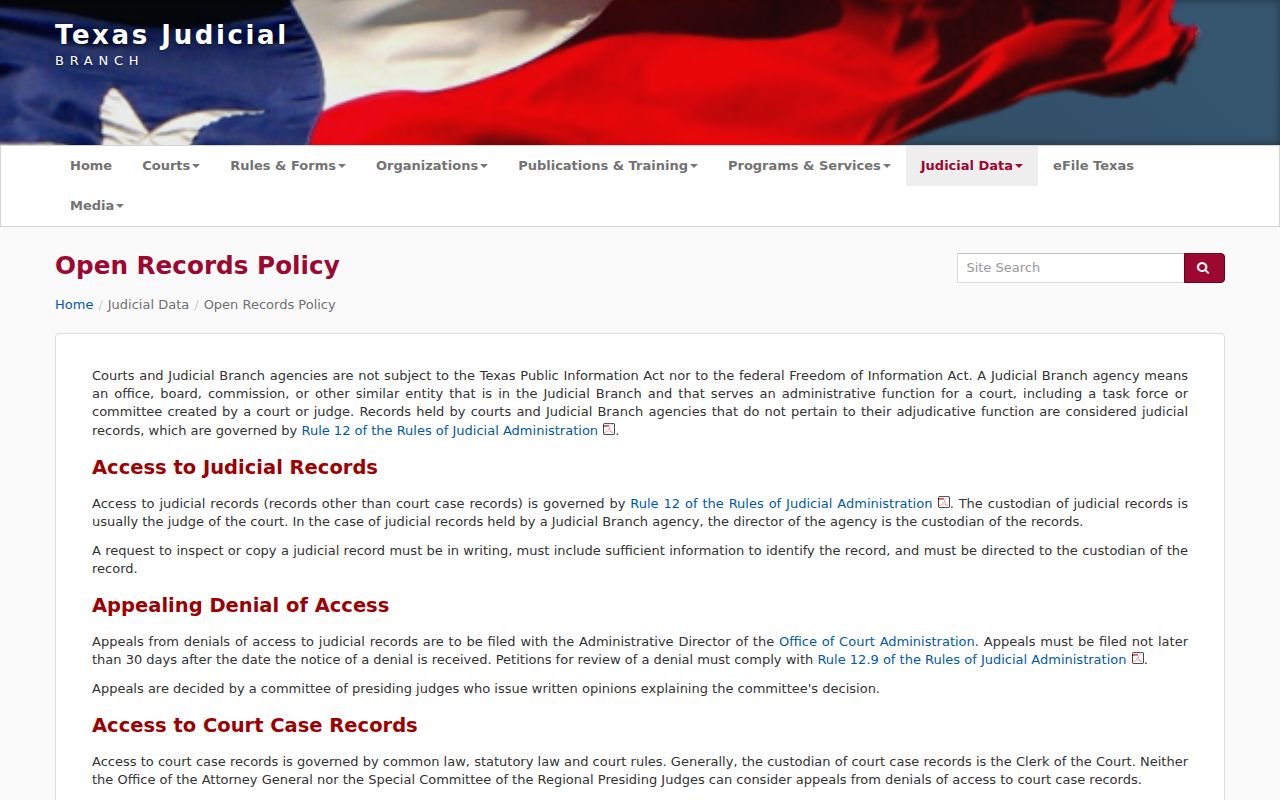
Texas courts point to Code of Criminal Procedure Article 15.26 for public access to arrest warrants and their supporting affidavits. That access still bends to other laws, court orders, redactions, and juvenile confidentiality. Court case records may follow Rule 12 instead. A Sheriff service record, meanwhile, can be handled as a public-information request. The custodian and the record type drive the answer. The image links to the courts' official access policy page, which spells out that distinction and points to the arrest-warrant access rule.
Sealed search-warrant affidavits and juvenile arrest warrants have separate restrictions.
Serving Arrest Warrants in Camp County
The warrant itself directs a proper peace officer to act. In Camp County, service may fall to the Sheriff, the countywide Constable, Pittsburg police, municipal peace officers, or another officer the process names. No office publishes a separate warrant unit schedule. There is no countywide assignment chart either. What the record shows is the return, which notes whether service occurred. After an arrest, the person goes before a magistrate without unnecessary delay. Camp County's indigent-defense plan sets a no-later-than-48-hours standard in the circumstances it covers, while bond and release conditions rest with the magistrate and any other hold. Keep in mind that a release does not end the underlying case.
Camp County Arrest Warrant Service
Three roles split the work. The issuing judge authorizes the process, the clerk keeps the case record, and an officer carries out the command. The Sheriff sits at 203 Tapp Street and publishes 903-856-6651 as its general number. The countywide Constable page lists an office and dispatch route but states no criminal-warrant assignment, so ask which agency received the specific order.
Camp County Sheriff's Office
203 Tapp Street, Pittsburg, Texas 75686
903-856-6651
The countywide Constable publishes a separate office and civil-process contact on the Camp County Constable page. The Texas Judicial Branch's live court directory identifies the courts, but neither source is an arrest-warrant roster.
A service contact is not the issuing court. For the case number, the order, or recall status in Camp County, use the court.
Camp County Arrest and Bench Warrants
Different papers, different jobs. A summons just tells you to show up, an arrest warrant allows custody on probable cause, and a bench or FTA process answers to a missed court obligation. In Camp County the lower courts may call that last one an arrest warrant or a capias when you expect bench warrant. Ask the court which one controls your case.
| Feature | Arrest Warrant | Summons | Bench Warrant |
|---|---|---|---|
| What it orders | Arrest and bring the person to court | Appear at a named date or place | Bring a person before the court after noncompliance |
| Basis | Probable cause | Notice or charging process | Missed appearance or court duty |
| Who issues it | Judge or magistrate | Court under the applicable process | Judge in the existing case |
| How to respond | Ask counsel and court about bond or appearance | Follow the appearance instructions | Ask issuing court about reset, recall, or payment |
Camp County Federal Warrant Routes
Federal cases run on a different track. The U.S. Marshals place Camp County in the Eastern District of Texas and point to the Joint East Texas Fugitive Task Force for that region. Treat those pages as jurisdiction and contact references rather than a public county warrant lookup. A PACER case search can pull docket material, but sealed entries stay hidden, and a docket sheet alone does not confirm a warrant. The link to PACER's case-search and account interface is a starting point, not a Camp County arrest record. Confirm federal process with the federal clerk or with counsel named in an official notice.

A county payment or recall does not clear federal process.
Camp County Arrest Warrant Confirmation
A message claiming an arrest warrant deserves questions. Ask which court issued it, the cause number, the offense, its current status, any bond amount, and whether a second hold exists. Verify the notice with a phone number from the official Camp County or court page, never the number in the message itself. The Sheriff posts no surrender or bond-window hours, so call before you go. A lawyer can reach the court about an appearance date, bond, or a motion to recall. Keep the written order or receipt, and check whether the underlying case stays open.
Camp County Arrest Warrant Next Steps
A name match means nothing on its own. Neither does a text that claims to be official. Verify the case with the issuing court first, then talk with a lawyer about appearing, surrendering, posting bond, or asking the court to recall or quash the warrant. Camp County sets out no walk-in process or bond schedule that fits every case. Before you go, call the Sheriff to learn which office holds custody and whether a separate hold could delay release.
Important: Ask counsel about a serious warrant before appearing. The court sets the process, and the Sheriff does not publish surrender or bond-window hours.