
Camp County Bench Warrants Explained
“Bench warrant” is a common reader term for court process after a missed appearance or other failure to comply. Camp County's JP and Pittsburg Municipal Court may use the statutory labels arrest warrant or capias rather than a paper titled bench warrant. Unpaid post-judgment fines may lead to a capias pro fine.
Other court orders can bring separate process. The 76th and 276th District Courts handle district matters, including family enforcement. A missed date does not tell a reader which document was issued. Ask the court for the exact order and case number.
Camp County Bench Warrant Timeline
A citation, promise to appear, or court order sets the first obligation. If a person misses it, the issuing court may record an FTA and decide whether to issue an arrest warrant or capias. If a judgment is already entered and remains unpaid, the court may use a capias-pro-fine process. The legal step depends on the case stage and court.
Process: court date or payment due › court records the missed obligation › judge decides the next order › officer serves it or the court later recalls it.
How Camp County Bench Warrants Are Issued
The judge or magistrate for the Camp County case decides whether the record supports a warrant or other process. A clerk preserves the docket but does not independently recall an order. The Camp County Sheriff, countywide Constable, Pittsburg police, or another proper peace officer may be directed to serve it, depending on the warrant.
No Camp County public list or local status-code chart was found. A court may require an appearance, motion, payment plan, bond, or other step. Ask the issuing clerk which action is authorized rather than assuming that a payment alone closes the warrant.
Camp County Bench Warrant and Capias Terms
Texas forms distinguish a pretrial capias from a post-judgment capias pro fine. “Recall” means the issuing court withdraws the process; “quash” means the court sets it aside, usually by order. Neither word necessarily ends the underlying case.
- FTA
- A recorded failure to appear as ordered or promised.
- Capias pro fine
- Post-judgment enforcement related to unpaid fines or costs.
- Recall or quash
- A court action that changes the warrant, with the case itself possibly still open.
Camp County Bench and Arrest Warrants
A bench-warrant question usually starts with an existing case and a missed court obligation. An arrest warrant is a command based on probable cause and may begin a new custody process. Texas forms may use overlapping labels, so the court's document title and case history matter. See Camp County arrest warrant steps for the separate probable-cause process.
| Feature | Bench Warrant | Arrest Warrant |
|---|---|---|
| Trigger | Missed appearance or other court duty | Probable cause of an offense |
| Issuing basis | Order in an existing case | Complaint or affidavit reviewed by judge |
| Case link | Often a citation or pending docket | New charge or charged conduct |
| Next step | Ask about reset, recall, or authorized payment | Ask counsel and court about bond or appearance |
Camp County Lower-Court Warrant Routes
The Camp County JP keeps countywide Class C and traffic cases at 115 Dr. M. L. King Jr. Avenue, Suite C, Pittsburg. Pittsburg Municipal Court handles city ordinance and municipal traffic matters at City Hall, 200 Rusk Street. Each court controls its own docket and recall decisions.
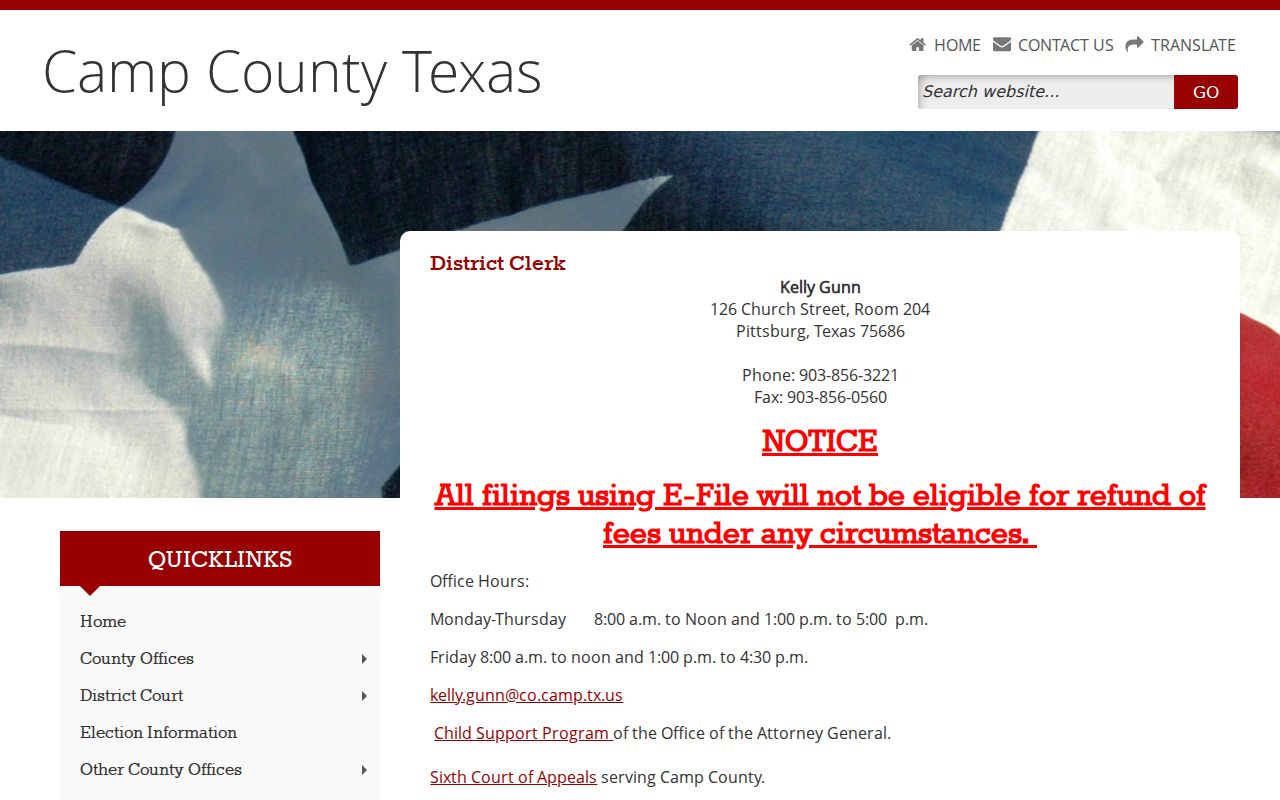
The Camp County District Clerk keeps district criminal and felony case files at 126 Church Street, Room 204. The court coordinator for the 76th or 276th District Court can route a pending setting. The image below is the District Clerk's contact page, not a case result.
Open the official District Clerk page to confirm current contact details.
For JP contact and weekday hours, use the official Justice of the Peace page.
County Court and probate-file routing is listed on the Camp County Clerk page; it is a separate record holder from the JP and District Clerk.
Resolving a Camp County Bench Warrant
Start by asking the issuing clerk whether the case needs a new date, an authorized payment, a motion to recall or quash, or a bond and appearance. For a JP matter, the clerk can explain plea and payment routes. Pittsburg's court publishes its own late-payment and installment instructions. A judge, not a payment site, controls recall.
- Give the court the cause or citation number and ask for the exact warrant or capias status.
- Ask whether payment, a new setting, community service, an indigency request, or a motion is allowed.
- Talk with a lawyer about a serious case, bond, surrender, or request to recall or quash the order.
- Keep the receipt or signed order and ask when the Sheriff, court, or DPS record will update.
Caution: Do not assume an old warrant has expired. Confirm the order with the court and ask a lawyer about the safest next step.
Camp County Warrant Recall Records
Ask for the existing warrant, return, recall or quash order, FTA report, and docket entry tied to the cause number. Court case records may use Texas Rule 12 or the clerk's process, while a service record held by law enforcement may be requested under the Texas Public Information Act. The office does not have to create a new clearance letter.
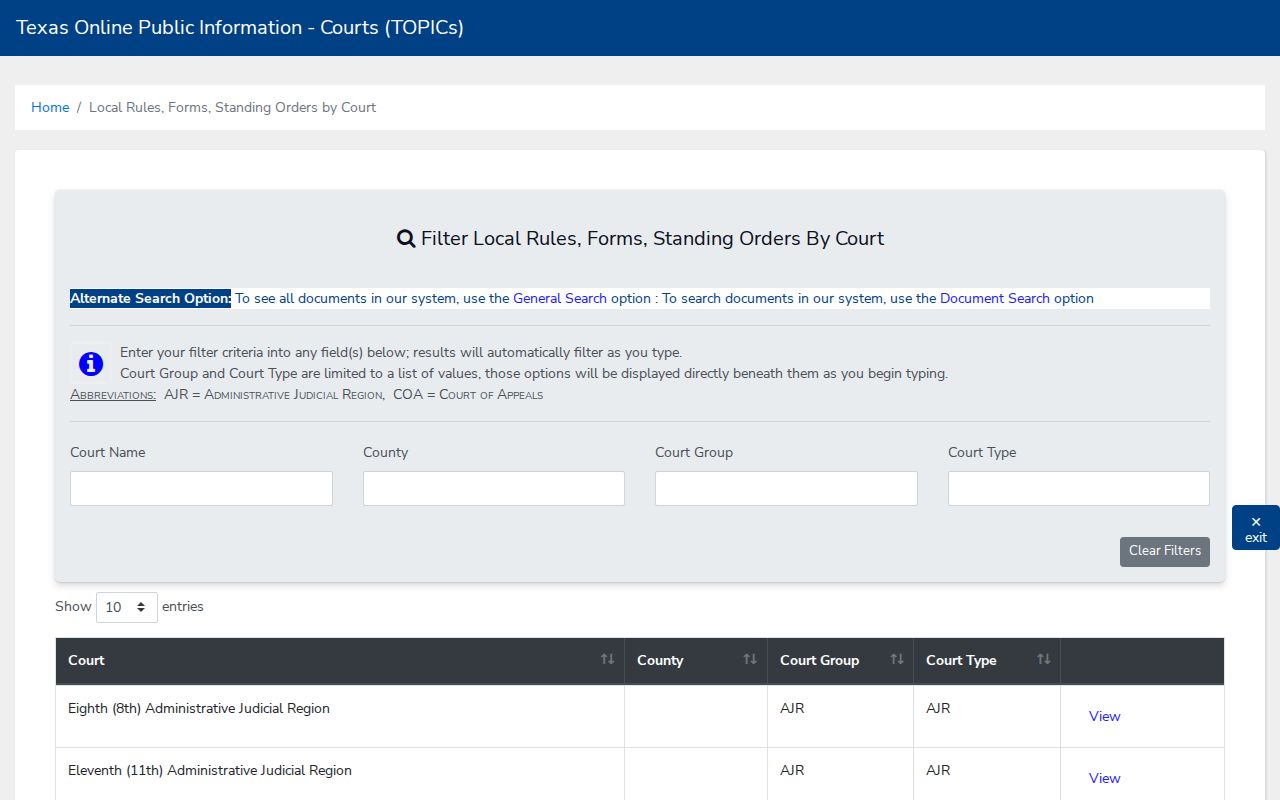
For Camp County, the Texas OCA Local Rules and Forms search can help locate a court's published rule or standing order. It is a discovery tool, not proof of an active warrant. The image shows its filters rather than a person's record.
Camp County's public pages did not provide a warrant-recall form or criminal recall fee. Confirm both with the issuing clerk.
Camp County Bench Warrant Confirmation
After the court gives instructions, retain the case number, contact date, payment receipt, new setting, and any signed order. Ask whether the process was recalled, whether a future hearing remains, and who will report a related FTA/FTP closure to DPS. A resolved warrant can leave the underlying citation or criminal case open.
No Camp County safe-harbor order or amnesty event was located. Use only current instructions from the named court.
Camp County Warrant Issuing Court
Use the citation, bond paper, or court notice to identify the court. Pittsburg Municipal Court handles a city case; the countywide JP handles its own traffic and Class C matters. County Court and district-level files route through the County Clerk or District Clerk. The Sheriff can direct a law-enforcement question but cannot replace the issuing court's decision on recall.
When the notice lacks a court name, ask for the cause number and issuing authority before traveling. The Camp County warrant resolution steps explain the county-level routes without treating every case as the same process.